
Virtual Graduate Information Sessions
Register TodayA Master’s Degree in Sport Coaching prepares coaches to serve at the youth, high school, recreation, collegiate and professional levels.
The flexible, online curriculum allows working adults to complete a degree while working or coaching in any location.The job outlook is strong, with higher than average job growth of 6% projected for coaches and scouts (Bureau of Labor Statistics, 2026).
Program Overview
 Prepare to coach to your highest potential with an interdisciplinary curriculum that includes foundations in leadership; the sport industry; administration; strength, conditioning, injury prevention, and nutrition; and sociology and psychology of sport. Taught by full-time faculty complemented by sports professionals, this 30-credit master’s program aligns with standards of the National Association of Sport and Physical Education’s Society of Health and Physical Educators (SHAPE) America (Society of Health, n.d.). Expand your breadth of experience through two sport coaching internships after completing your foundational course work. In the final capstone, you will develop your base coaching philosophy through exposure to multiple sport industry coaching philosophies.
Program Benefits
- Learn theories and skills to develop your own coaching philosophy.
- Gain hands-on experience through two internship placements with sport coaches and athletic administrators.
- Balance your studies with coaching, work, and family through a flexible online program with a combination of synchronous and asynchronous offerings.
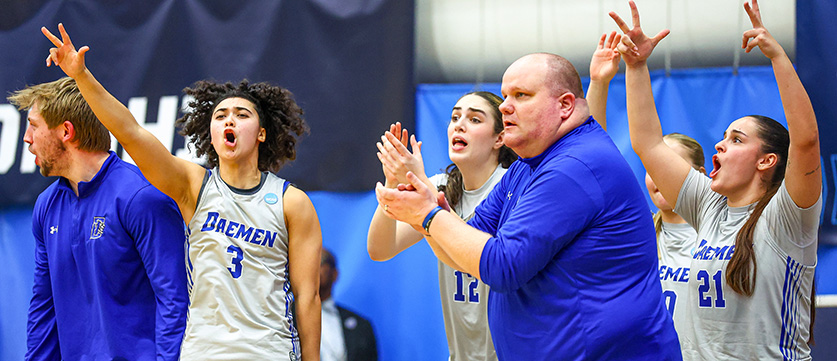
- Learn in an environment supported by an active NCAA Division II athletics program with 17 sports.
Program Objectives
Students in the Sport Coaching program will:
- Critically evaluate a range of coaching philosophies and leadership models across diverse sport contexts, identifying their strengths, limitations, and appropriate applications.
- Analyze how coaching philosophies intersect with personal identity, including personality traits, emotional intelligence (EQ), values, and prior experiences, to assess individual readiness for effective coaching practice.
- Develop, articulate, and refine a comprehensive personal coaching philosophy that guides decision-making, athlete development, and program culture.
- Apply coaching philosophies to real-world scenarios, including practice design, competition strategy, communication, and athlete motivation.
For All Applicants:
- Bachelor’s degree from an accredited college or university, or an equivalent degree from a foreign university or college.
- CPR and First Aid certification required for all students. Students will be required to show proof of completion of certification before taking SPC 601: Integrated Management of Athlete Safety and Performance.
- One letter of recommendation from an instructor familiar with the applicant.
- A written statement describing educational objectives and areas of professional interest.
- A virtual or on-site interview with the graduate program director/department chair.
- Minimum QPA requirement is 3.0. Students between a 2.8 and 3.0 GPA may be accepted for conditional/probationary admittance, but will not constitute more than 30% of the program enrollment.